Travertine slabs: characteristics and minimum recommended thickness
Travertine and marble are two iconic natural stones, often confused by their beauty and prestige. But geology, appearance, performance and applications are very different. If you’re considering travertine slabs for floors, cladding, or facades, it’s crucial to understand the differences from marble and know the minimum recommended thickness to ensure durability and safety.
Difference between marble and travertine? Geology, appearance and applications
Marble is a metamorphic rock, born from the transformation of limestones subjected to high heat and pressure. It is compact, dense, with fluid grain and homogeneous colors. Its surface is generally smoother and less porous than travertine.
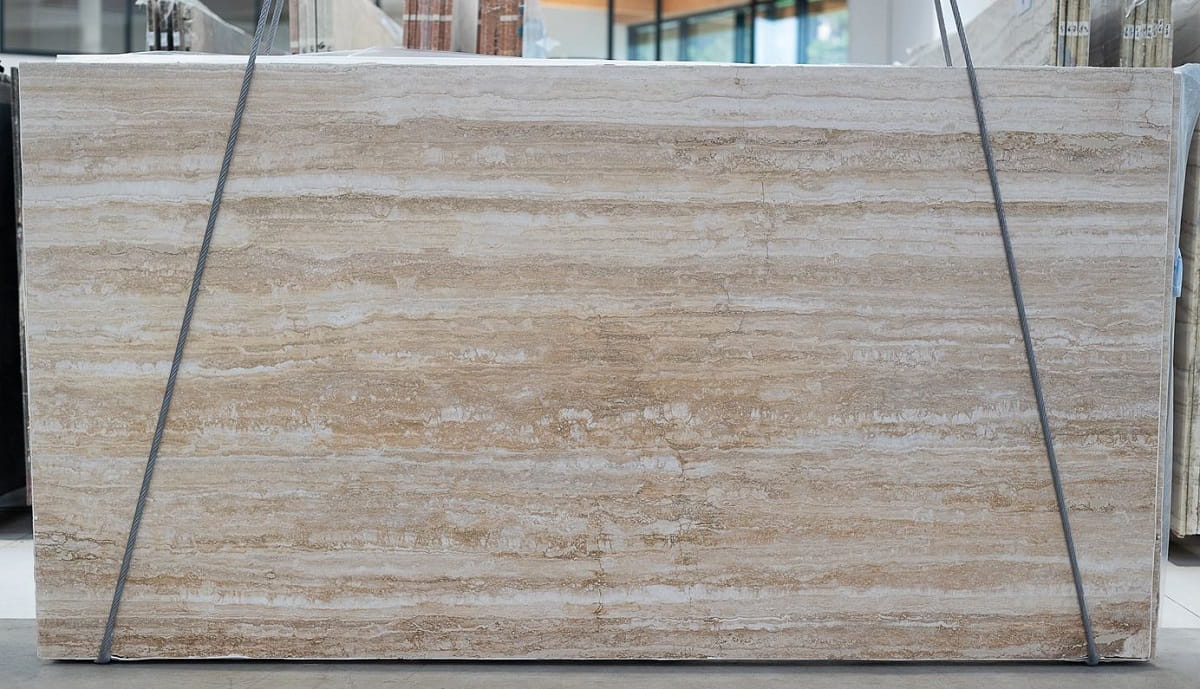
Travertine, on the other hand, is a calcareous sedimentary rock, formed by the deposition of calcium carbonate in thermal or river waters. It is characterized by natural cavities (called “alveoli”), irregular veins and a more porous and rustic surface. The colors range from beige to hazelnut, from red to white, with warm, earthy shades.
Differences between the two materials:
– porosity: travertine is more porous than marble, so it absorbs more water and requires more maintenance;
– strength: Marble is harder and more resistant to abrasion; travertine is more fragile but more non-slip;
– appearance: the marble is elegant and refined; the travertine is rustic, natural, Mediterranean;
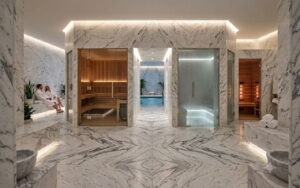
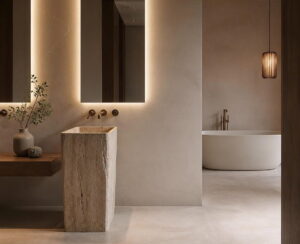
– applications: Marble is ideal for interior floors, stairs, bathrooms; travertine is perfect for exterior floors, facades, cladding, garden furniture.
Choose marble if you are looking for luxury, brilliance and refinement. Choose travertine if you prefer warmth, naturalness and an authentic Mediterranean look.
What is the minimum recommended thickness for travertine? Guidelines for floors, cladding and facades
The thickness of travertine sheets depends on the application:
– interior floors: minimum 2 cm (20 mm) for sanded or brushed slabs. For ballasted or non-slip finishes, 3 cm (30 mm) is recommended for greater strength;
– external floors: minimum 3 cm (30 mm), better 4 cm (40 mm) if subject to vehicular traffic or frost;
– vertical cladding: 2 cm (20 mm) is sufficient, but for external facades or windy areas 3 cm is recommended;
– steps and thresholds: minimum 3-4 cm, with reinforced edge to prevent chipping.
For structural applications or high loads, always consult a technician: travertine, although resistant, is more fragile than granite and requires adequate supports.
Why choose Venetian Gold travertine sheets
Our travertine slabs are selected for density, compactness and beauty of the grain.
Each plate is controlled to ensure performance and durability, with customizable thicknesses for each application.
Whether you’re designing a villa, hotel, or public space, Venetian Gold travertine is the choice for those seeking authenticity, warmth, and long-lasting durability.
Would you like more information on the topic of “Travertine Slabs”?
Call us on our landline +39 0431 624553 or send your request to the email info@venetiangoldluxury.com to request your free consultation.
Also follow us on our Instagram page to stay updated on our latest creations and news.